





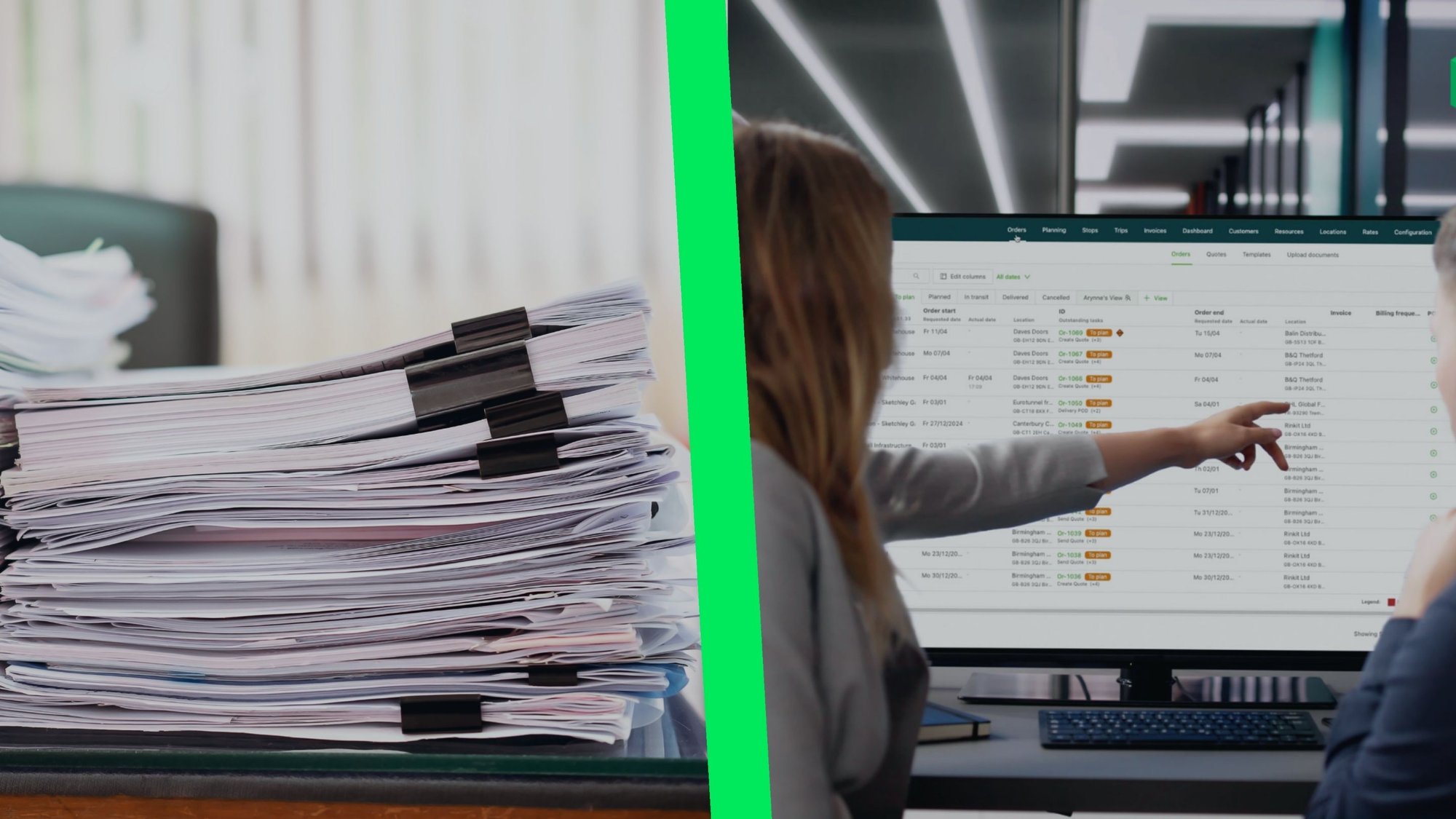
In transport, for every order, every stop, every signature there is a document changing hands, and more often than not, that paperwork moves slower than the truck does. Digital documentation changes that: instead of trailing behind the shipment, the data keeps pace with it – captured the moment something happens, ready to be used immediately.
This blog looks at the power of digital documentation, what it can unlock for transport operators, and how our new integration with TransFollow ties into this conversation.
What digital documentation unlocks in transport
Documents are used at nearly every step of the transport flow. From order entry forms and cleaning certificates, to PODs and invoices, the movement of goods is often only as efficient as the speed at which documents are processed.
Transport documents act as proof that a key milestone has taken place and you can move to the next step, i.e. a POD/CMR confirms that goods have been delivered and this is essential in order for invoicing to take place. And with paper processes, you often have to wait for your drivers to return before getting the POD/CMR and then manually entering the data – pushing back the timeframe for you to invoice.
Digital documentation means that what once was a static record is now live data as it’s captured the moment something happens.
And even more importantly, digitising documents allows them to be part of an automated workflow with each piece of information triggering the next step automatically.
Examples of this flow include:
- A signed eCMR that triggers invoicing the instant it’s captured, instead of sitting in an inbox for days
- A digital POD that updates a customer’s shipment status in real time, no phone call needed
- A GPS/timestamped signature that settles a damage dispute in minutes instead of weeks of back-and-forth
- A customs or CO₂ record that’s usable data the moment it’s created, not a PDF someone re-types later
All of these automations build efficiencies into your workflow and reduce the time your team spends on admin – giving them time back to focus on revenue-generating activity.
Digital documents build trust and transparency
Digital documents aren’t just faster – they’re more verifiable.
They reduce the chance of illegible signatures, disputed timestamps, or “the original got lost” excuses as there’s one centralised source of truth that all parties can work from.
Carriers, shippers, and customers can view the same verified record and this shared confidence reduces friction long before a dispute could pop up.
Each digital document brings standalone benefits by providing real-time insights, but the real advantage comes from the connected visibility across the entire transport flow.
Where Qargo fits in
At Qargo, our mission is to automate and digitise the manual, repetitive parts of the transport flow. We’re strong believers that benefits compound when data flows through one connected workflow rather than sitting in separate tools.
We saw time and time again that PODs/CMRs were causing bottlenecks for transport operators.
That’s why our driver app already lets drivers capture proof of delivery directly at the stop — no separate upload, no re-entry back at the office. And now, with our TransFollow integration, the complete order-to-invoice workflow can stay connected through Qargo.
Qargo and TransFollow integration
With TransFollow integrated into Qargo, the eCMR process happens without ever leaving the platform. When a job’s ready, the dispatcher creates the eCMR straight from the consignment – shipper, consignee, goods, and references already filled in – gives it a quick check, and issues it.
From there, it’s simple for the driver. At pickup and delivery, they just tap “Sign eCMR” in the Qargo app, and TransFollow opens automatically – no separate login. The shipper or consignee signs right there on the screen, or if nobody’s around to sign, the driver logs that too.
Once it’s signed, the document comes straight back and attaches itself to the order as the signed CMR, giving teams the delivery proof they need to move the order forward. No chasing paperwork – everyone can see exactly where it stands (draft, issued, in transit, delivered, or cancelled) right there on the consignment.
Conclusion
Going digital means that documents stop being something you only check after the fact and become data that works for you the moment it’s created — a signature that closes the loop on delivery, a record that everyone can trust without a phone call to confirm it. That’s what turns paperwork into proof, and proof into speed.
If you want to see how our TransFollow integrations fits into your current Qargo workflows, reach out to your Qargo contact or book a demo.