



About the company
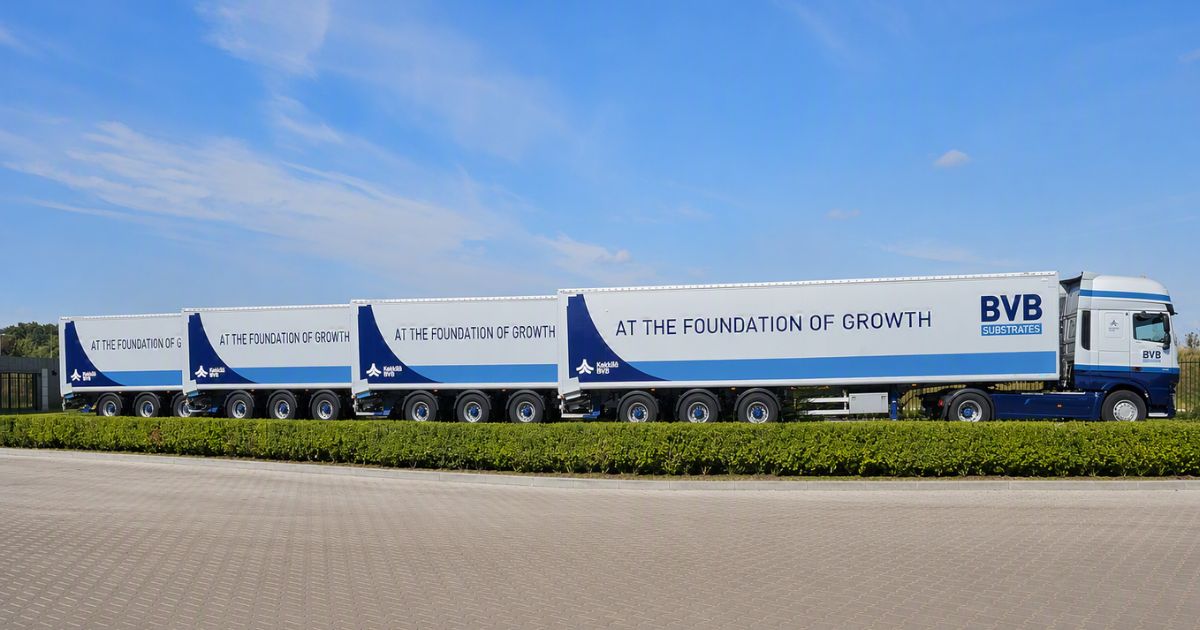
Kekkilä-BVB Logistics is the transport division of Kekkilä-BVB, a leading producer of growing media for the horticulture sector. Whether it’s bags of potting soil for garden centers, big bags for nurseries, or bulk deliveries straight to the silos of professional growers — for many crops, substrate forms the foundation, and Kekkilä-BVB Logistics handles the transport.
The logistics division, responsible for five production sites in the Netherlands, manages all bulk and pallet transport for the entire group. As the transport arm of a manufacturing company, the team actively contributes to supply chain decisions, combining deep product knowledge with an unwavering focus on on-time delivery. “It’s all about the right moment, the right place, and the right vehicle,” says Rob Timmermans, Logistics Manager. That combination of flexibility, speed, and reliability is what sets Kekkilä-BVB Logistics apart.
How they found Qargo
It didn’t start with a TMS search. It started with a much bigger digital transformation. The IT department flagged the problem first: their existing system had run its course, both functionally and from a security standpoint. A new ERP was needed — and with it, a new approach to transport. Kekkilä-BVB Logistics did what any well-connected logistics team would do: ask around. “We started asking within our transport network which TMS systems other companies were using,” Rob explains. The name Qargo kept coming up. What began as word of mouth is now a three-year partnership.
The challenge
Before implementing Qargo, Kekkilä-BVB consisted of several production sites that had been brought together through acquisitions, but whose logistics were not initially organized centrally. Each site worked with its own processes, systems, and ways of working, operating largely on its own — digitally as well. Planning knowledge lived mainly in employees’ heads, which meant onboarding a new planner took a lot of time and could sometimes take up to two years.
The existing solution — a custom-built module on top of a legacy system — had served its purpose for a single site. But it was never designed for what the company had become: a centralized transport operation responsible for moving goods from and between five factories, with real-time visibility expected at every step. Status updates were largely missing, and there was little structured insight into the actual progress of shipments. As a result, route planning and timing were hard to predict and not consistently recorded. When the company decided to bring all transport under one roof, the gap between what the existing system could do and what the operation needed became clearly visible.
“In the past, everything lived in our planners’ heads. Now we get all of that into the system.” — Rob Timmermans, Logistics Manager, Kekkilä-BVB Logistics
The solution
With Qargo TMS as the central foundation of the logistics operation, transport movements from five factories were brought together into one platform. This gave planners a real-time, clear overview of vehicle deployment, delivery progress, and order status — a clear step forward compared to the previously limited and fragmented flow of information.
But the most notable development? Automatic resource allocation. Developed in close collaboration with the Qargo team and largely driven by Rob and his colleagues, the feature does exactly what its name suggests: as soon as an order comes in with a loading location and a destination, the right subcontractor is automatically assigned. No manual assignment. No phone calls. No duplicate work. Three of the five factories now run entirely on this automation — and the results speak for themselves. “At first there was doubt about whether we were ready to roll out resource allocation,” Rob admits. “But as order volumes rose, so did the risk of errors. That’s why we went live after two to three weeks anyway. And you saw the effect immediately: week after week, the allocation of vehicles and resources improved.” Order entry for external transport was transformed as well. What used to take five to ten minutes per order now takes less than a minute, thanks to Qargo Intelligence’s (Qi) AI features — faster, more accurate, and with documentation automatically attached.
“By centralizing transport and bringing all flows together in one system, total order volume within planning has effectively doubled. Yet we’re still handling the work with the same number of planners.” — Rob Timmermans, Logistics Manager, Kekkilä-BVB Logistics
Integrations
To connect the full logistics chain, Kekkilä-BVB Logistics integrated Qargo with several key systems:
Microsoft Dynamics 365: The driving force behind the manufacturing company. Orders flow automatically from D365 to Qargo, are processed by the planning team, and status updates are automatically fed back, ensuring a seamless flow of information between order processing, planning and logistics.
Trimble (telematics & absence planner): The integration was set up in about ten minutes. When a driver submits a leave request through Trimble’s absence planner, they’re automatically marked as unavailable in Qargo — making it impossible for a planner to accidentally schedule them. A small change that eliminated a persistent, error-prone manual step.
Descartes (EDI integration): Communicating with large haulage partners requires more time and patience for the EDI integration — mapping data field by field to ensure information is translated correctly between systems. The work is still ongoing, but the automated status updates it enables are already making a difference.
The onboarding experience
Go-live took place on September 1, 2025. The integration setup required the most effort: working through the data mapping field by field, together with Qargo’s integration team and an external ERP consultant. “It took a lot of energy and many hours of patience,” Rob acknowledges. But support was there throughout the entire process. As go-live approached, the first week ultimately went more smoothly than expected. “The rollout within the logistics department went largely smoothly and under control. As with any implementation of this scale, we did encounter some challenges along the way, particularly around processes and system integrations. Thanks to good collaboration and short lines of communication, we can respond quickly and keep improving.” The guidance from Qargo’s account management team made a real difference. “You’re guided step by step, get solid training in Qargo, and then apply it yourself. Our account manager really changed the way we look at a TMS, and that’s changed how I approach the system as a key user.”
The results
The centralization project — which couldn’t have happened without Qargo — is now delivering real, measurable results across the entire operation:
✅ Double the volume, same team: 200–300 orders per day with five planners — thanks to centralization and a more efficient process.
✅ 90% of orders across three factories are automatically assigned via resource allocation.
✅ Order creation time cut from 5+ minutes to under 1 minute for external transport via Qargo Intelligence (Qi).
✅ Real-time status visibility for planners and the manufacturing business via the D365 integration.
✅ Dutch mileage levy fully automated: mileage surcharges for subcontractors calculated and applied automatically, with no manual intervention.
✅ Faster onboarding of planners: institutional knowledge now lives in the system, not just in people’s heads.
“If we hadn’t had Qargo, centralizing all transport into one department would never have worked.” — Rob Timmermans, Logistics Manager, Kekkilä-BVB Logistics
Why it matters
In a market where margins are under pressure and hiring is getting harder, growing without adding headcount is essential. Kekkilä-BVB Logistics shows this is possible: through automation, centralized data, and a TMS that supports the operation, a team of five planners today handles a volume that used to require more people spread across multiple locations.
“As a transport manager, you always have to stay open to the question: which tools can help my organization? Sometimes the answer is hiring an extra employee — but you can also ask which software can take you to the next level.” Advice worth taking seriously, from someone with 23 years of experience in the sector.
What’s next
The EDI connections with major haulage partners are being rolled out further. The D365 integration is also being deepened, with the next goal being automatic delivery status updates as soon as a vehicle arrives at a factory gate. Looking ahead, Rob has his eye on route optimization software — whether standalone or built into Qargo — that can automatically generate intelligent planning suggestions. “That would be the next step. Our work is quite specific, with specialized equipment, but the potential is definitely there.”
“Connecting real-world operations with what software can do — that’s what Qargo does for us.” — Rob Timmermans, Logistics Manager, Kekkilä-BVB Logistics
🚀 Want to see how Qargo can transform your transport operations? Book a demo